 |
The Town of Oldham |
|
|
|
The Town of Oldham |
|
Extract From: A Topographical Dictionary of England, by Samuel Lewis. Vol. III, London, 1831
OLDHAM, an enfranchised borough, a parochial chapelry, and the head of a union, in the parish of Prestwich, hundred of Salford, S. division of the county of Lancaster. This place has within the last seventy years much increased in importance, from the rapid progress of its manufactures, for which it is indebted to its vicinity to Manchester, and to the mines of excellent coal in the neighbourhood. The town is situated on elevated ground, near the source of the river Irk, and is bounded on the east by a branch of the Medlock; the houses are irregularly built, but since the extension of its manufactures, the place has been very much enlarged, and has undergone considerable improvement. It was first lighted with gas in 1827, by a company who also supply the town with water; the water is supplied by iron pipes, from a reservoir covering about twelve acres of ground, in Strines-dale, about two miles and a half eastward, partly in Lancashire and partly in Yorkshire. The affairs of the town are regulated by commissioners appointed under a police act obtained in 1827, which also provided for the building of a town-hall and other offices. The buildings on the terrace, erected by private enterprise in 1836, contain a public room and a room intended for a market; and there are a subscription library, founded in 1807; a lyceum, in 1839; and a mechanics' institution.
Oldham was for a long period celebrated for the manufacture of hats, which was established so early as the fifteenth century, and is still carried on to a small extent. The principal manufactures now are, those of fustians, velveteens, cotton and woollen corduroys, and the spinning of cotton, the last being the most considerable. In 1785 the number of cotton-mills was six; in 1815 the number was 47; in 1839 it had increased to 94, and it is at present much greater: they are all worked by steam. A great quantity of the coal which is obtained in the neighbourhood is sent to Manchester, and the collieries, being exceedingly productive, afford occupation to a large part of the population. The number of steam-engines employed within the borough, in cotton spinning and weaving, machine-making, ironfounding, bleaching, and logwood-grinding, in the year 1846, was 179; in raising coal, 58; and in grinding corn, 1; making a total of 238 steam-engines, of 5695horse power. The trade at the western extremity of the town is much facilitated by the Oldham canal, constructed in pursuance of an act obtained in 1792; it commences at Hollinwood, and forms a direct communication with Manchester, Ashton-under-Lyne, and Stockport. The Rochdale canal passes through the township of Chadderton. There is a branch to the Manchester and Leeds railway, from Oldham; and in 1846 an act was passed for making a branch, 4¼ miles long, to the Manchester and Huddersfield railway: an extension of the former branch, from the west part of the town to Mumps, or Greenacres moor, on the east, was opened November 1, 1847. A market for provisions is held on Saturday; and fairs take place on the first Thursday after Old Candlemas-day, on May 2nd, July 8th, and the first Wednesday after October 12th, for horses, cattle, sheep, and pedlery.
The chapelry is co-extensive with the borough, and comprises 11,138 acres, of which the arable land is scarcely a fifth of that in pasture. Among the mansions are, Werneth, Chadderton, Royton, and Foxdenton Halls. John Frederick Lees, and George Lees, Esqrs., are the lords of the manor.
The free grammar school was founded in 1611, by James Assheton, Esq., of Chadderton Hall. In 1747, Samuel Scholes gave £16 per annum, for which children of the township of Oldham are instructed. Thomas Henshaw, Esq., a native of the town, bequeathed £20,000 for the endowment of a Blue-coat school at Oldham, and a like sum for an asylum for the blind at Manchester. The first stone of an edifice for the school was laid at Oldham-Edge, in April, 1829; and the school was opened on the 25th June, 1834, with 50 boys, which number was increased in 1846 to 130. There are a head master and two ushers: the boys are admitted at nine years of age, and remain till they are fourteen, when they are apprenticed to trades. To all the churches in the chapelry are attached national schools. Three benevolent relieving societies are maintained; and a savings' bank has been established, the depositors in which, in 1845, amounted to 763, and the sum deposited to £17,374. The poor-law union of Oldham comprises eight townships in the parishes of Prestwich and Middleton, containing a population of 72,058.
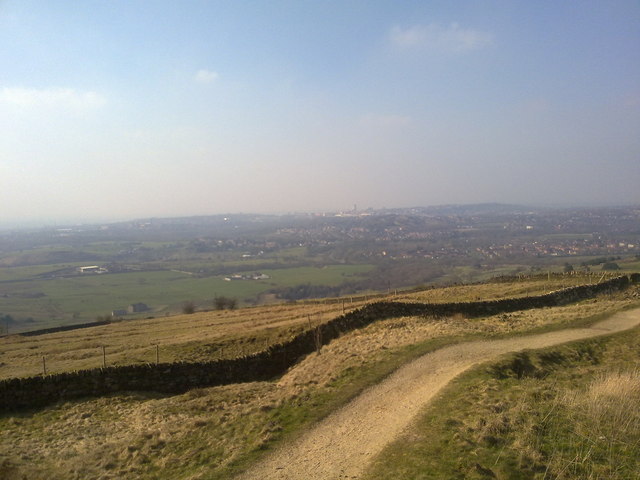 Oldham from Hartshead Pike
|
| Oldham Home & Contents | ©Lancashire OnLine Parish Clerks | Lancashire Home |
![Creative Commons Licence [Some Rights Reserved]](http://creativecommons.org/images/public/somerights20.gif)