 |
Rosehill URC, Great Bolton |
|
|
|
Rosehill URC, Great Bolton |
|
 | |
From The Bolton Journal and Guardian, Friday, May 14, 1937, reproduced here by the kind permission of the Bolton News.
It is well nigh impossible to think of Rose Hill Congregational Church without including in the retrospect its present minister and his wife, the Rev. F.W. and Mrs Lloyd Jones, for they have been the church’s leaders for nearly half a century now.
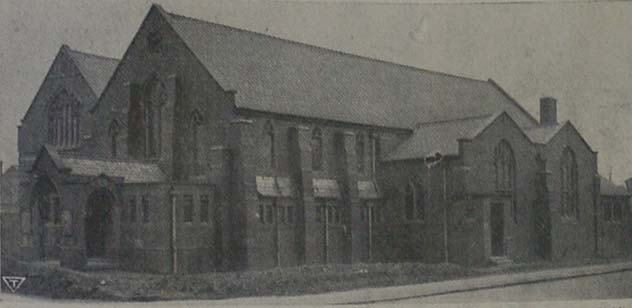
One tremendous change has been perhaps the outstanding event of the church’s material progress during Mr Lloyd Jones’s pastorate – the removal from the old Nelson-st. building to the fine new premises on Bradford-rd, Great Lever. His ministry at Rose Hill certainly extends over the more important half the church’s history, for the cause at Great Lever is now nearly a century old.
In the thirties of last century Rose Hill was a rural spot, with lovely gardens in summer time filled with roses, and with fields and meadows separating it from the town. Its reputation was not akin, however, in its rural charm, for in those days it was said to be in a “notorious depraved condition.”
It was also described as an “uncivilized district,” where drunkenness prevailed, and where cock-fights were a popular pastime.
Strangers to this neighbourhood were often vilely abused as they passed through the streets. This, however, did not deter – more probably it encouraged them – the congregation of Mawdsley-st. Independent Chapel from sending a band of workers to open a Sunday school in the neighbourhood and “to make known the Gospel in this benighted neighbourhood.”
The first step was taken in 1849 when the Rev. W. Jones began to negotiate for a small building, and in the following year, the Sunday school was opened.
The building he secured bore the words “Christ Church” over the door and had originally been built for a body of people known as “The Vegetarians,” who later disposed of it to a group of “Socialists” – so they were then described – from whom the Mawdsley-st. people bought it.
The room accommodated 150 people and had a basement used as cellar dwellings. In addition to Sunday school and occasional religious services, educational classes were held on week-nights.
Such was the feeling in the district that, according to one old boy, “it took some courage either to join the school or to become identified with its work.”
Eventually, however, the early hostility and opposition passed into approval and helpfulness.
For a quarter of a century the “Dumpling School” – a name which clung to the chapel later for some inexplicable reason – was the scene of Christian activity, but in 1863 an urgent appeal was made for funds for a new school-chapel.
In 1864, additional land was secured and the old school premises were demolished. The foundation stone of the new school-chapel was laid on June 23rd, 1864, by Counc. Wilkinson, the address being given by Dr. Vaughan.
Unfortunately the business failure of a builder delayed the completion of the school-chapel, and throughout a long and severe winter the scholars met in a portion of a tumble-down shed.
This formed part of the Robin Hood Mill, which had been partly burned down a short time before. Under these conditions the attendance gradually dwindled until at times there was only one class crouching round a little stove in the shed.
There was great relief, therefore, when the new school-chapel was finished.
With the opening of this building it was decided to secure the services of an evangelist, and first Mr. Fielding and then Mr. R.H. Noble worked for a period under the minister at Mawdsley-st.
When Mr. Noble left, the Rose Hill congregation applied for their “dismissal” from Mawdsley-st. in order to become an independent church.
Accordingly in 1870, 37 people were “dismissed” from the mother church and the newly-formed church gave a call, which was accepted, to the Rev. David Williams. H e began his work at Rose Hill towards the close of the year 1870.
He remained there for 18 years, and then accepted a temporary pastoral charge at New Amsterdam, British Guiana, where he died in 1890.
For some years the need for extension had become more acute, and in 1890 the foundation stones of a new school to accommodate 800 or 900 scholars were laid.
This new school enabled the chapel to be extensively altered, and an organ was installed.
In 1889 a young man from what is now Paton College preached at Rose Hill and made such an impression that although his college course had still two years to run he was given a call to the pastorate. This he accepted, and entered on his duties in Sept. 1891. He was the Rev. F.W. Lloyd Jones, and is still guide and counsellor as well as spiritual teacher of the Rose Hill congregation.
He had turned 60 years of age when he was faced with the fact that the old church had to be vacated, and the enormous task of erecting a new church and school presented itself. With the ardent zeal and loyal co-operation of the members of the church the work was under-taken, and the congregation now possess a fine group of buildings on Bradford-rd., where the new church was opened in 1925. The entire scheme is stated to have cost about £18,000.
| Bolton Home & Contents | ©Lancashire OnLine Parish Clerks | Lancashire Home |